How to Tell What Type of Hdmi Port I Have
HDMI Explained
According to the HDMI Forum website, more than ane,700 manufacturers have sold over 8 billion HDMI-enabled devices, making HDMI the nigh popular way to transmit uncompressed audio and video between a source and a receiver or display.
What is HDMI?
HDMI ways High-Definition Multimedia Interface, a standard for simultaneously transmitting digital video and audio from a source, such as a computer or Tv set cable box, to a computer monitor, Idiot box or projector. Originally developed by a consortium of electronics manufacturers, it has been widely adopted with almost all televisions and computer monitors supporting the interface.
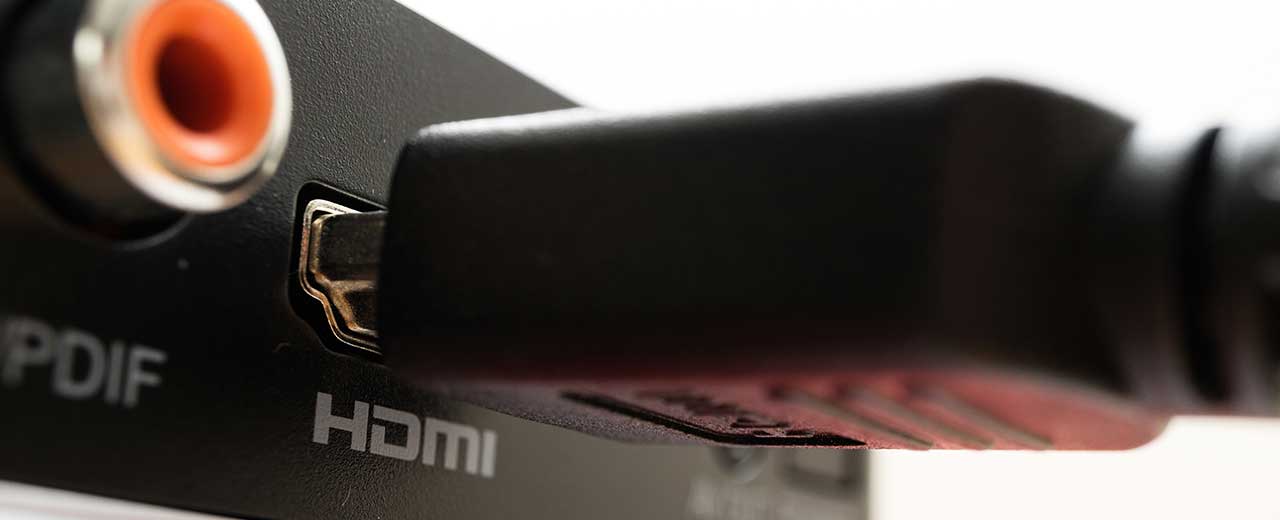
The goal of the HDMI initiative back in 2002 was to improve on existing connectivity standards (due east.m. DVI, component video) past creating a smaller connector, adding support for embedded audio and delivering a higher resolution video betoken. Such was HDMI's success that by 2008, shipments of HDMI-enabled devices exceeded those of DVI. Past the finish of 2009, all HDTVs had at least i HDMI port.
HDMI Cables
The HDMI interface allows a port to send high-resolution digital video, theatre-quality sound and device commands through an HDMI connector and downward a unmarried HDMI string, each designed to back up a video resolution and features in the HDMI specification.
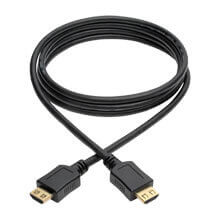
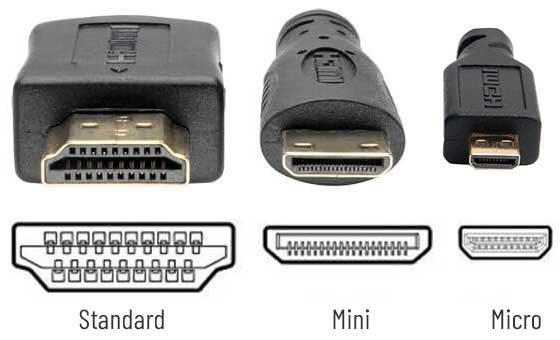
HDMI connectors are available in three sizes: standard, mini and micro.
At that place are likewise unlike types of HDMI cable (see the chart beneath). Not all cables use the logo simply the cable specifications should indicate whether it is Standard, Loftier Speed, Premium High Speed or Ultra High Speed. If the blazon is not indicated, presume Standard.
HDMI Ports and Connectors
The majority of HDMI connectors in utilize today are the Type A (Standard), Type C (Mini) and Type D (Micro) shown beneath. HDMI Type B (Dual Link) was developed for very high-resolution displays simply was never used. Also not shown is the HDMI Type Due east connector which is intended for automotive and industrial applications.
The Standard HDMI connector (Blazon A) is the most widely used of the five HDMI connector types. These 19-pin connectors tin be found on almost every brand of TV, computer monitor, game console, streaming device and desktop computer.
Mini HDMI connectors (Type C) also accept 19-pins and support the same features as the full-sized Type A connector in a smaller, more compact course factor. Because of its smaller size, it is typically used on portable devices such as DSLR cameras and tablets.
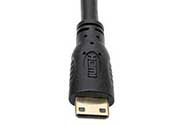
The smallest HDMI connector, Micro HDMI (Type D), is about half the width of the Mini HDMI connector even so still retains the full functionality of its larger siblings. Micro HDMI connectors are used on pocket-sized, portable devices such equally phones.
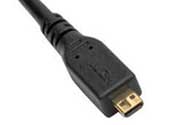
Cables are available in male and female person versions, with infinite-saving correct-angled connectors and gripping or locking connectors.
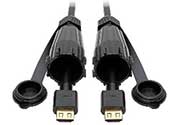
IP68 HDMI Connector
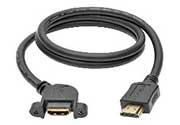
Console Mount HDMI Connector
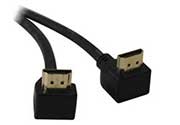
Right-Angled HDMI Connector
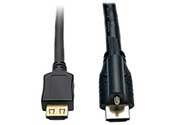
Locking and Gripping
HDMI Connectors
HDMI cable is considered low voltage so y'all tin can install it inside a wall. HDMI faceplates give a clean, finished advent and take a female connector on the internal side, making termination like shooting fish in a barrel. HDMI keystones are also available for digital signage applications and large conference facilities with many displays that are fed from a primal location.
Gripping and Locking HDMI Connectors
HDMI connectors do non latch like DisplayPort connectors but some do provide a spring mechanism that makes the bract of a male connector grip the receptacle and makes it less likely that the cable will be accidentally pulled out. If an HDMI device may be subject to vibration or accidental movement, use a connector with a screw lock.
Which is best... in-wall HDMI cable or wireless HDMI?
A cablevision connection is a relatively inexpensive option that gives a potent, reliable signal simply can be difficult to install, it'southward express to one location and a distance of 25-l-ft., depending on the resolution. Longer distances require an active cable or HDMI extender. A wireless HDMI extender is much easier to install, can exist easily relocated and tin can broadcast a high-resolution video signal to multiple receivers.
Notation: In-wall HDMI cables have a CL2 or CL3 rating. This ways that the cable jacket is fire resistant and suitable to low-voltage in-wall applications.
Is there a deviation in functionality between the Standard, Mini and Micro HDMI connectors?
All three connectors have the aforementioned xix pins, but some may accept different pin assignments. Functionally, they all back up the resolutions and features of HDMI 1.iv onwards.
Can a USB-C Port be used to Transmit HDMI to a Monitor?
Yes. In Alt Mode, some of the pins in a USB-C connector are used to transmit other protocols. This allows the widely adopted USB-C port/connector to be used for more than just USB information or power. To date, there are four Alternate Modes: DisplayPort, Mobile High-Definition Link (MHL), Thunderbolt and HDMI. HDMI Alt-Way supports all of the features of HDMI 1.4b, including video resolutions of 4K @ 30 Hz and in a higher place.
I need an HDMI cablevision for my 4K Idiot box. What should I buy?
Purchase a Loftier Speed HDMI cable that supports at to the lowest degree HDMI 1.4, the start HDMI standard to support 4K signals. To get a 4K picture, all components must back up 4K: the cable box or streaming service, the HDMI cable and the Television set. If you are using an old Standard HDMI cablevision purchased before 2009, it will non accept the bandwidth to bear a 4K HDR signal.
Evolution of the HDMI Standard
| Specification | Twelvemonth | Video | Sound Support | ||
|---|---|---|---|---|---|
| Max. Resolution Refresh Rate* | Max. Transmission Charge per unit** | HDR | |||
| HDMI i.0 | 2002 | 1080p @ sixty Hz | four.95 Gb/s | No | 8 audio channels |
| HDMI i.1/1.ii | 2005 | 1440p @ xxx Hz | four.95 Gb/s | No | DVD-Audio, One-Bit Audio |
| HDMI one.3/1.4 | 2009 | 4K @ 60 Hz | 10.two Gb/s | No | ARC, Dolby TrueHD, DTS-HD |
| HDMI two.0 | 2013 | 5K @ thirty Hz | 18.0 Gb/southward | Yes | HE-AAC, DRA, 32 sound channels |
| HDMI ii.1 | 2017 | 8K @ 30 Hz | 48.0 Gb/s | Yes | eARC |
* Higher refresh rates are possible using Display Stream Compression (DSC).
** HDMI encodes data and uses some of the available bandwidth to ensure the integrity of the signal. This means that the actual information rate is something less than the maximum transmission charge per unit. For example, under HDMI 2.1, the maximum transmission rate is 48 Gbps but the maximum date rate is 42.6 Gbps.
HDMI one.0
- Initial release of the HDMI standard
- Audio and video interface for the transfer of video and audio over a single cable
- Data transfer up to 4.95 Gbps
- 1080p at 60 frames per second (UXGA)
- viii-channels of 192kHz/24-bit uncompressed sound (PCM)
- Playback of standard Blu-ray video and audio
HDMI 1.1/ane.ii
- DVD Audio
- Back up for YCbCr color space
- Support for low voltages sources, such as PC video cards using PCI Express
- HDMI Standard (Blazon A) connector for PC applications
- Consumer Electronic Control (CEC)
HDMI 1.3/one.3a
- Increased bandwidth to 10.two Gb/s
- Increased color depth to 10-fleck, 12-fleck, or 16-bit per channel ("Deep Color")
- xvYCC color infinite back up
- HDMI Mini connector (Type C) for use with portable devices such as camcorders
- Support for Dolby TrueHD and DTS-HD Master Audio formats
HDMI 1.4/1.4a
- Support for HDMI Ethernet Channel (HEC)
- Back up for 3840 x 2160 at 30Hz and 4096 x 2160 at 24Hz
- Sound Return Aqueduct (ARC)
- HDMI Micro connector (Type D) for utilise with phones
HDMI two.0
- Increased bandwidth to 18 Gb/s
- 4K at 60 Hz
- 8b/10b indicate encoding
- Back up for 32 audio channels
- Support for ultra-wide 21:9 picture palace aspect ratio
HDMI 2.1
- Increased bandwidth to 48 Gb/s
- Resolutions up to 10K at 120 frames per second
- Dynamic HDR
- Brandish Stream Pinch (DSC) one.2a
- Enhanced Audio Return Channel (eARC)
HDMI Features
Transition-Minimized Differential Signaling (TMDS) – When digital data is transmitted, peculiarly over long distances, it is susceptible to dissonance and indicate loss. TMDS is a style of encoding an HDMI signal to protect it from interference as it travels from source to receiver. It works like this:
- The sending device encodes the betoken, organizing the ones and zeros to reduce the chance that the signal will dethrone.
- Two copies of the signal are transmitted over different internal wires, one an "out-of-phase" version of the actual signal.
- The receiving device puts the out-of-phase signal back in stage and compares the two versions, ignoring any differences (dissonance) betwixt the two.
Consumer Electronic Command (CEC) – This characteristic allows a user to control up to fifteen continued HDMI devices using i remote controller. Almost TVs and streaming devices back up CEC but it may exist turned off by default. Manufacturers sometimes refer to CEC using their ain branded term (e.chiliad. Anynet+, Viera Link) so it may not be credible that your device supports it.
High-Bandwidth Digital Content Protection (HDCP) – this authentication protocol allows a sending and receiving device to verify each other'due south credentials (stored on each device's Extended Display Identification Data (EDID) flake) and, if every checks out, create a shared key that is used to encode and decode the information passing between them. This process, known as a handshake, happens almost instantaneously at the start of a session and ensures that an unauthorized device cannot intercept the data as it travels betwixt two devices. In the United States, HDCP support is mandated by the Federal Communications Commission (FCC).
Display Data Channel (DDC) – The HDMI interface includes support for VESA DDC, a set of protocols that allow a source (a computer's graphics carte du jour, for instance) to ask a monitor what audio and video formats it tin handle, and suit settings on the monitor, such as brightness and dissimilarity. The data exchanged past a source device and a display is chosen Extended Brandish Information Information (EDID) and is transmitted through the Display Data Aqueduct.
Chroma Subsampling – Chroma subsampling is a form of video information compression. It reduces the corporeality of color data in a video signal in such a way that there is little or no visible affect on prototype quality.
Each pixel in a video image includes information on effulgence (luma) and color (blush). Since human eyes are more than sensitive to differences in brightness than color, chroma subsampling reduces the corporeality of data transmitted by allowing pixels to share colour information with adjacent pixels.
Chroma Subsampling is represented as three digits. The first number is the number of pixels in each row of the sample. The second number indicates the number of pixels in the TOP row that have color information. The third number indicates the number of pixels in the BOTTOM row that have color information.

- 4:4:4 means no subsampling. Each pixel has its ain color information
- 4:2:2 indicates that ii adjacent pixels on each row share colour information, representing a 50% reduction in color data
- 4:2:0 means the bottom row has no colour information and uses the information provided for the top row. This approach reduces the color information by 75%.
Color Spaces and Deep Color – A colour space is a defined range of colors that can be represented in an paradigm. The 2 primary color spaces used to stand for digital video are RGB and YCbCr. Ii important characteristics of a color infinite are Color Depth and Gamut. Colour Depth is the number of bits used to stand for the color of a single pixel and determines the amount of shading or gradation. Gamut refers to the number of colors available.
The initial HDMI specification provided support for 24-bit Color Depth (8-bits per color x iii colors RGB). HDMI 1.3 introduced Deep Color, which added support for 30-chip, 36-scrap and 48-bit color depths. It's worth keeping in mind that the human eye tin can simply distinguish around 10 1000000 dissimilar color, and then 24-flake colour is adequate for most situations.
Color Depths
| Color Depth | Bits per Color | As well Known As | Gamut | HDMI Specification |
|---|---|---|---|---|
| 24-Flake Color | 8 | True Color | xvi.7 meg | i.0 |
| 30-Bit Color | 10 | Deep Colour | 1.073 billion | 1.3 |
| 36-Bit Colour | 12 | 68.71 colors | ||
| 48-Bit Colour | 16 | 281.5 trillion |
Audio Return Channel (ARC) – Virtually TVs connect to a sound bar or AV receiver using an optical cable. ARC enables a Television to send audio back to a sound bar or AV receiver through the aforementioned cablevision that delivered the HDMI signal to the TV. In other words, video and sound to the Television receiver and audio back to the sound bar (the "return" part). The benefits of ARC include fewer cables, use of the TV remote to control audio, and the power to transmit higher resolution audio, such as Dolby TrueHD or DTS HD Master Sound, to your sound bar or receiver. [Version ane.4]
HDMI Ethernet Channel (HEC) –Offset introduced in the HDMI 1.4b specification, HEC allows Ethernet-enabled devices to share an Net connection. Information technology combines the features of an Ethernet cable into the HDMI cablevision, thereby avoiding the need for a separate Ethernet cable. Xbox 360 and Roku are two examples of devices that can accept advantage of HEC to connect to the Cyberspace. [Version 1.four]
Dynamic HDR – Loftier Dynamic Range (HDR) is achieved by sending additional information with the video signal that tells the Idiot box or monitor how to brandish the content. Information technology results in greater brightness, contrast, and improve color accuracy equally compared to Standard Dynamic Range (SDR). Dynamic HDR simply means the dynamic range tin can be assail a per-scene footing (or frame-past-frame in the example of high-end TVs).
Enhanced Audio Return Channel (eARC) was introduced in HDMI ii.1 and provides support for higher-quality sound bandwidth and speed. eARC requires a High Speed HDMI cablevision with Ethernet or an Ultra Loftier Speed HDMI cable. eARC is not backwards compatible with ARC merely some products may support both eARC and ARC. [Version ii.one]
Display Stream Compression (DSC) – HDMI is uncompressed audio and video. The college the resolution, color depth and frame rate, the more bits need to be transmitted until the maximum bandwidth is reached. Then, the simply manner to transmit more $.25 is to add more lanes to the cablevision or compress the signal.
HDMI 2.ane introduced back up for Display Stream Compression (DSC) 1.2a, a visually lossless compression for ultra-loftier definition (UHD) video. Using DSC, an HDMI 2.1 cablevision can support a maximum compressed bandwidth of 128 Gbps (sufficient for 10K, although it will be some time before there are commercially bachelor devices that need that much bandwidth).
Transmitting HDMI Signals
Active vs. Passive HDMI Cables
A passive HDMI cable is a simple cablevision associates with an HDMI connector at each terminate. Passive cables have a limited range (more than on this afterward). Active cables on the other hand include a signal booster that enables video and audio to be transmitted over longer distances. Agile cables sometimes require a power supply.
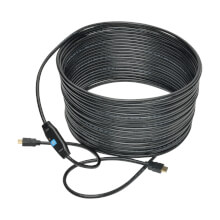
HDMI Cable Length
Passive Cables – Opinions vary over the maximum length of a passive HDMI cable. Consensus seems to be about 50 feet for 1080p and 25-feet for 4K video, merely distances of over 50-feet are achievable. A proficient practical approach is to endeavour a passive cablevision and, if you take problems with point forcefulness, add an in-line signal booster at the receiver end. Tripp Lite Model Number B122-000-4K6 will heave a 4K/60 Hz indicate up to 50-ft and B122-000-60 will extend a 1080p/60 Hz signal up to 125-ft.
Agile Cables – Length is more definitive in the case of an active cable considering signal transmission is designed and tested over the advertised distance. For example, Tripp Lite's P568-065-Human activity active HDMI cablevision will support video transmission up to 65-ft.
HDMI Extenders
When transmission distance requirements exceed the limits of passive and active cables, it's fourth dimension to consider the diverse forms of bespeak extension.
In-Line HDMI Point Extender – For distances up to fifty-anxiety, an in-line equalizer or repeater can extend a 4K/lx Hz indicate upwards to 50 anxiety and a 1080p/60 Hz signal up to 125-ft. Greater distances are possible at lower frame rates.
HDMI over Cat5 and Cat6 – A Cat5/half dozen extender will catechumen the HDMI indicate into similar Ethernet IP packets that tin can be transmitted over the category cable and reconverted at the other cease with no loss of signal strength or allegiance. Using this arroyo, an HDMI betoken can be transmitted well-nigh iii times further than an active HDMI cable–approximately 100 meters (328 ft.). Shielded (STP) Cat6 cable is recommended for its ability to reduce EMI interference from power lines and crosstalk within the cable.
HDMI over Cobweb – The connectors on fiber HDMI convert conventional electrical inputs to pulses of light that are transmitted at loftier speed through optical fiber, then converted back to electricity on the receiving end. Since signal manual is optical, it isn't subject to EMI/RFI line noise. HDMI over Fiber can exist extended well across the 100 meter/328-pes limit of copper Ethernet cable.
Wireless HDMI Extenders – A hardwired extender uses an Ethernet or Agile Optical Cablevision to laissez passer data between a transmitter and receiver. A wireless extender sends the HDMI betoken using ane of the WiFi protocols (east.g. 802.11ac or 802.11n). Wireless is more often than not slower than hardwire and so brand certain the video resolution and frequency is sufficient for your needs. For example, Tripp Lite'south B127-1A1-WHD1 can extend a 4K/xxx Hz signal up to 98-ft.
Converting To and From HDMI
HDMI and Thunderbolt 3
Tin I connect a TB3 port to an HDMI display?
Yeah, just not directly. Thunderbolt three has native support for DisplayPort and from DP y'all can go to HDMI past way of an adapter. Yous can also use an adapter cable like Tripp Light's U444-006-H4K6BE to convert DP Alt Style to HDMI.
HDMI to DisplayPort / DisplayPort to HDMI
Tin can I connect DisplayPort to an HDMI display?
Yes, a DisplayPort to HDMI adapter cable allows yous to connect a reckoner with DisplayPort video output to an HDMI-enabled monitor or Idiot box. If yous use a passive cablevision, make sure the video source is a DP++ (DisplayPort ++) dual-mode port. If your graphics bill of fare does not support DP++, use an agile cable such as Tripp Lite P582-006-HD-V2A.
Tin can I connect a DisplayPort monitor to an HDMI port?
Yes. Fifty-fifty though HDMI and DisplayPort utilize different signal protocols (TMDS vs. LVDS), it is possible to convert HDMI to DisplayPort with no loss of image quality using an agile adapter. The adapter may require an external power source. The Tripp Lite P130-06N-DP-V2 4K HDMI to DisplayPort Active Adapter uses power from the USB-A port.
HDMI to DVI
Tin I connect an HDMI port to a DVI monitor?
Yeah, HDMI and DVI video signals are compatible. An HDMI to DVI adapter will support resolutions up to 1920 x 1200. Still, DVI will not back up HDMI audio.
HDMI Alt Style over USB Type-C
USB Alt Mode allows a USB-C connector or port to transmit non-USB signals, making information technology extremely versatile. For example, a laptop, Chromebook or Android phone might use Alt Way to directly connect a USB-C port to an HDMI-enabled monitor without the need for an adapter. This is an important feature because many laptops and tablets have a USB-C port but no HDMI port.
To accept advantage of HDMI Alt Mode, you lot need a USB-C port that supports USB Ability Delivery. Information technology is the PD handshake that establishes an Alt Style connection. Y'all will also need a cable with a USB-C connector on i end and a USB-C or HDMI connector on the other. Older USB-A cables do not support Alt Fashion.
Another option is to utilize an adapter cable supporting DisplayPort Alternating Style, such every bit Tripp Light's U444-006-HDR4BE, to connect a USB-C port to an HDMI display.
As a general rule, video and audio can be converted from one protocol to another equal or lesser protocol as the tabular array below shows. Protocol conversion requires an adapter.
Blue: Standard cables and no protocol conversion
Green: Adapters and Adapter Cables
Switching and Splitting HDMI Signals
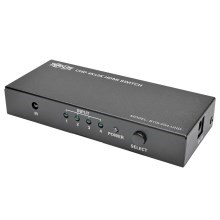
Switches and splitters are frequently confused and for good reason. They perform similar functions. A switch takes multiple inputs and lets you cull which one to display on your TV or reckoner monitor. A splitter does exactly the opposite. It takes a single video signal and replicates information technology to multiple displays.
HDMI Splitters
An HDMI splitter takes one HDMI video signal and sends it to multiple displays. Each brandish will evidence the aforementioned epitome. Splitters are ofttimes classified according to their inputs and outputs. For example, a ii-port splitter might be referred to equally "1x2" because it has one input and two outputs.
When choosing a splitter, make sure the output is at the resolution and frequency you want. A video splitter may as well perform protocol conversion, for example, converting DisplayPort to HDMI.
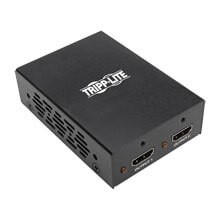
HDMI Switches
An HDMI Switch, as well called a Presentation Switcher, outputs sound and video from multiple sources merely only i at a time. For example, a boardroom presentation might include Powerpoint slides and video from a streaming service like YouTube or Vimeo.
A matrix switch has multiple inputs AND outputs. For instance, a 9x2 matrix switch has 9 inputs and ii outputs.
Another variation on the many-to-i theme is the Multiviewer, which consolidates a number of video inputs on a single monitor. Multiviewers are establish in broadcast command rooms and video surveillance systems.
Can I extend my desktop using an HDMI splitter?
No, an HDMI splitter takes one video signal and replicates it to multiple displays so each brandish shows the aforementioned paradigm. This is known equally "mirroring". Here are your options for extending your desktop:
- If your laptop has an available DisplayPort or Mini DisplayPort port and you lot want to add an external HDMI monitor, apply a DP or mDP to HDMI adapter.
- If you have a laptop with a USB-C port and want to add an external HDMI monitor, consider a multiport adapter with an HDMI video port.
- If you lot have an available USB-C or Thunderbolt port and desire to add ii or three external monitors, use a dock.
HDMI Surge Protectors
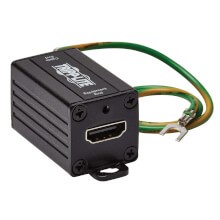
A power surge is typically a brief increment in voltage due to, for example, an overloaded excursion, power outage or lightning strike. A surge protector detects excess voltage and safely diverts it through the edifice's grounding system so information technology doesn't impairment connected equipment.
HDMI surge protectors are intended to supplement chief surge protection and are installed "in line" between a video source and brandish.
Of import: surge protectors do not provide two-way protection against power spikes. If you want to protect both source and display, you should install 2 surge protectors: one with its output facing the video source and one with output facing the brandish.
Do in-line surge protectors degrade the HDMI point?
All in-line surge protectors introduce a small impedance into the line and a capacitance across the line. Tripp Lite's in-line HDMI surge protector (Model Number B110-SP-HDMI) is designed with lower line capacitance and impedance to avoid Transition Minimized Differential Signaling (TMDS) loss.
HDMI Audio Extraction
An HDMI signal includes both video and sound, which is convenient because you need only one cablevision to connect a cable box, game console or streaming device to your tv set. But if you want to play audio through an older analog audio system that doesn't accept HDMI support, you will need to separate the audio rail from the video. That's where an audio extractor comes in.
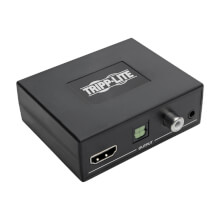
An HDMI Sound Extractor splits an HDMI signal into a separate HDMI signal and an audio output. Depending on the capabilities of the audio extractor, you may have the choice of compressed or uncompressed (LPCM) audio outputs, for instance, three.5mm stereo or a multi-channel format similar vii.1 surround sound via TOSLINK.
When ownership an audio extractor, make certain the video and audio output formats match the capabilities of your television and sound system.
HDMI vs. DisplayPort
HDMI and DisplayPort are similar standards with a different focus. HDMI has been widely adopted past consumer electronics manufacturers. DisplayPort'due south primary focus is computer connectivity and professional audio/video applications.
If y'all need to connect a Blu-Ray thespian, cablevision box, game panel or streaming device to your television, HDMI is the logical choice. Your options for connecting a computer monitor to your laptop or desktop PC may exist less clear. Many computers (and docking stations) offer both HDMI and DisplayPort. Which i will requite y'all the best results? In terms of image quality, there isn't much deviation. DisplayPort 2.0 has a higher bandwidth, allowing information technology to back up higher resolution video, but there are currently few applications requiring video beyond 4K. However, if you lot need multiple displays, you lot can daisy-concatenation three 4K monitors @ 90 Hz or two 8K displays @ 120 Hz.
| HDMI ii.1 | DisplayPort 2.0 | |
|---|---|---|
| Released | 2017 | 2019 |
| Typical Application | Consumer TVs | Computer Monitors |
| Max. Transmission Rate | 48 Gbps | 77 Gbps |
| Max. Resolution (uncompressed) | 4K @ 144 Hz 5K @ threescore HZ 8K @ 30 HZ 8K @ 120 HZ (DSC*) | 4K @ 240 Hz 8K @ 120 Hz 16K @ 60 Hz |
* Brandish Stream Compression (DSC)
What's Side by side for HDMI: 16K Video?
With 8K TVs and cameras now readily bachelor, offset adopters are turning their attending to even higher resolutions, including 10K and 16K, and refresh rates above 60 Hz.
Bandwidth is the biggest bulwark to higher resolutions and refresh rates. Ignoring all of the extra data layered on meridian of the video itself, the simple formula (resolution x refresh rate x color depth) adds up to a lot of bits which need to be moved from a video source to a display. An uncompressed 8K, 24-bit color video betoken at sixty Hz needs well-nigh 50 Gbps of data bandwidth.
The current HDMI specification tops out at 8K/120 Hz so a revision will be required to go beyond that.
Products Mentioned in this Article
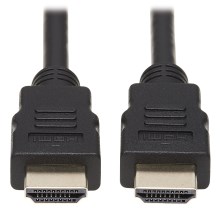
HDMI Cables
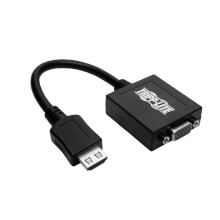
HDMI Adapters
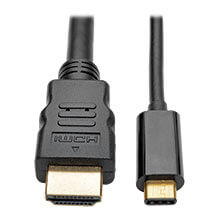
HDMI Adapter Cables
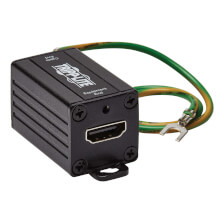
HDMI Surge Protectors
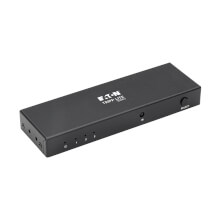
HDMI Switches
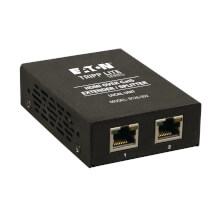
HDMI Splitters
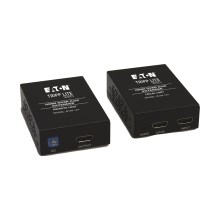
HDMI Extenders
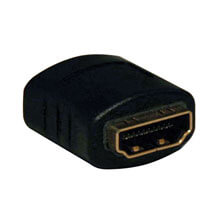
HDMI Couplers
Why Buy from Tripp Lite?
We know you lot accept many brands to choose from. On the surface, they may all seem alike. It'due south what you don't encounter that makes the difference. With Tripp Light, you get solid applied science, proven reliability and infrequent customer service. All our products undergo rigorous quality control before they are offered for auction, and independent testing agencies verify our products come across or exceed the latest condom and performance standards. Our commitment to quality allows the states to back our products with manufacture-leading warranties and responsive customer service. It's the Tripp Lite deviation.
Source: https://www.tripplite.com/products/hdmi-cable-types
0 Response to "How to Tell What Type of Hdmi Port I Have"
Post a Comment