How Much Money Was David Cassidy Making a Week Doing the Partridge Family
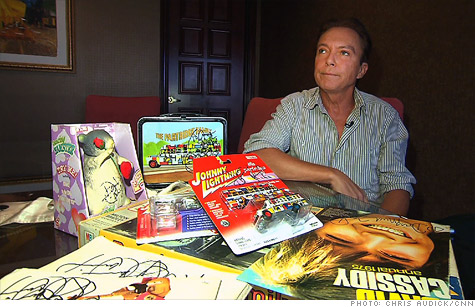
Cassidy said he was only paid $5,000 for merchandise from "The Partridge Family unit." He was supposed to get 15 percent of net merchandising revenues.
LAS VEGAS -- A CNNMoney and CNN Special Investigations Unit of measurement exclusive report. "Hollywood Hustle?" will exist part of a CNN Presents hour on Dominicus, Aug. 7 at eight p.chiliad. and 11 p.m. ET.
In a hotel suite just hours before going on stage, David Cassidy is signing the famous lunchbox from "The Partridge Family," the 1970s television evidence in which he starred and performed his hit records.
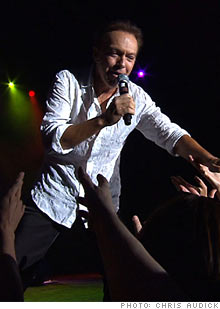 |
| Cassidy is all the same performing at diverse times during the year around the country. He says he'll accept his battle to become paid for merchandising equally far as necessary. |
Today, 37 years later the show went off the air, Cassidy is still filling showrooms with hits like "I Call up I Love You."
Simply he won't be singing that vocal to Sony, which owns "The Partridge Family unit."
Cassidy told CNN that Sony Corp. (SNE) has failed to pay him "a fortune" for what he'south owed for merchandise from the show.
"It'due south just ludicrous and unfair and wrong. It's greed," the 61-year-old actor said.
Cassidy said he was only paid $v,000 for trade from "The Partridge Family." Nether his 1971 contract with Screen Gems, a division of Columbia Pictures Industries which is owned by Sony, Cassidy was supposed to get 15 percent of internet merchandising revenues for the use of his image, vocalisation or likeness.
The show, which aired from 1970 to 1974, spawned merchandise such as lunchboxes, Colorforms' David Cassidy dress-upward sets, pins and board games.
"I don't want to shame and embarrass and humiliate them, simply I will if I have to," Cassidy told CNN. "You lot owe me a fortune -- y'all want to go to trial, big bad Sony confronting David Cassidy, become alee."
In a alphabetic character to Sony, Cassidy's attorney Craig Marshall, requested a full bookkeeping of the trade.
"Nosotros are formally requesting an accounting and payment for whatsoever and all sale, exploitation or other use of Cassidy'southward proper noun, likeness, voice or other exercise of such merchandising rights," states the letter to Gregory Boone, executive vice president of legal diplomacy for Sony Pictures Television. "In that regard, nosotros as well asking a prompt and full accounting and payment of proceeds for whatever trade that was sold, exploited or otherwise used subsequent to the rights period set forth in the agreement."
Boone responded in a letter of the alphabet that Sony "could not (and then far every bit we know did non) enter into any new merchandising licenses" using Cassidy'due south "proper name, voice and likeness rights" after the evidence went off the air.
"We have searched for copies of the merchandising net proceeds rendered to Mr. Cassidy in the 1970s, but have been unable to locate them," the letter said. "Even so, we did find some correspondence ... showing that Mr. Cassidy's representatives audited such statements. Therefore, they must take been rendered to him."
The letter of the alphabet said that any potential claims are invalid, considering the "statutes of limitation" had expired decades agone.
Sony officials told CNN they had no comment.
When asked why he waited so long to raise the merchandising issue, Cassidy said he didn't accept a copy of his contract until -- later a string of moves and business organisation managers -- he found it in a box that he hadn't opened since the 1970s.
"My easily started to milkshake. There was the contract," he said.
Too his claims that he was cheated out of merchandising revenues, he said new merchandise from the show has continued to exist produced in the concluding ten years. Since the merchandising rights reverted to him one year later the show went off the air and he was entitled to profits from the evidence, he said he was also supposed to get paid for whatever new merchandise.
For instance, Cassidy showed us "The Partridge Family" toy motorcoach and model kit with a 2001 copyright. The company that manufactured the toy, Playing Mantis Inc., has since been sold. Only a spokeswoman for the new visitor confirmed that the toy was produced in 1998 and again in 2001, with Sony's permission.
A toy hamster that sings "I Think I Dearest Y'all" too has a 2001 copyright from Gemmy Industries Corp. Lio Chang, a company vice president, told CNN that Gemmy got permission to use music from a Sony subsidiary.
Still some other "Partridge Family unit" toy bus has a 2003 copyright from CPT Holdings, which is Columbia Pictures Television -- however some other Sony subsidiary.
A Sony spokeswoman had no comment when CNN asked about these recent copyrights.
The only other cast member reached past CNN from "The Partridge Family" who said he received money from merchandising is Brian Forster, who replaced Jeremy Gelbwaks equally Chris Partridge in the 2d season. Forster said he received about $1,100, after his female parent demanded payment from the studio.
The other cast members contacted by CNN said they either didn't have a merchandising clause in their contracts, or do non call up getting paid.
Cassidy's comments to CNN follow interviews earlier this year with cast members of "Happy Days," who are suing CBS over the same issue.
Actors Don Most, Anson Williams, Marion Ross and Erin Moran, as well equally the widow of actor Tom Bosley, filed a $ten million accommodate in April, claiming CBS, which owns the show, failed to pay them for "Happy Days" merchandise, which is all the same beingness sold around the world.
Subsequently the lawsuit was filed, CBS Corp. (CBS, Fortune 500) sent checks to the actors totaling $43,403. But Jon Pfeiffer, the actors' chaser, said he would not greenbacks the checks while the case is pending because that would imply his clients concur with CBS that is all they are owed.
In a argument, CBS said it agreed the "Happy Days" actors are owed money for the trade, merely dispute the corporeality. In a court filing, the visitor said the actors are "attempting to generate a lucrative litigation windfall, past riddling their complaint with unsupported and overreaching causes of action" for fraud and breach of expert faith. CBS said this was "all done in a transparent attempt to innovate the specter of punitive damages" in the example.
But the actors fired back in court papers, saying "although defendants routinely rebrand their corporate images, they should not be permitted to rebrand the truth."
Unhappy days: The story in pictures
"Happy Days is the type of evidence that represents the best that we could exist," Williams told CNN. "Information technology's something warm, something tactile, when life was skilful and life was uncomplicated -- when friends were friends and neighbors were neighbors. And for this to happen to this type of show, I call up it's going to ring in peoples' hearts because information technology's going to go beyond this show."
For Cassidy, he said the upshot with "The Partridge Family" is the same -- where did all the merchandising money get?
"Information technology's articulate. It'south simple," Cassidy said. "I don't want to sue you; I don't want to have to do that. Just be fair. Be real, be genuine -- don't exist greedy."
Source: https://money.cnn.com/2011/08/04/news/companies/david_cassidy_partridge_family_lawsuit/index.htm
0 Response to "How Much Money Was David Cassidy Making a Week Doing the Partridge Family"
Post a Comment