How Did Leonardo Da Vincis Experiments Influence His Art
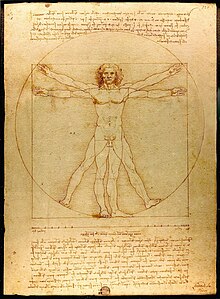
Leonardo da Vinci (1452–1519) was an Italian polymath, regarded as the epitome of the "Renaissance Man", displaying skills in numerous various areas of study. Whilst most famous for his paintings such as the Mona Lisa and the Terminal Supper, Leonardo is also renowned in the fields of civil technology, chemical science, geology, geometry, hydrodynamics, mathematics, mechanical engineering, optics, physics, pyrotechnics, and zoology.
While the full extent of his scientific studies has merely become recognized in the last 150 years, during his lifetime he was employed for his technology and skill of invention. Many of his designs, such as the movable dikes to protect Venice from invasion, proved besides costly or impractical. Some of his smaller inventions entered the world of manufacturing unheralded. As an engineer, Leonardo conceived ideas vastly ahead of his ain fourth dimension, conceptually inventing the parachute, the helicopter, an armored fighting vehicle, the apply of concentrated solar power, a calculator, a rudimentary theory of plate tectonics and the double hull.[1] In practice, he greatly advanced the state of cognition in the fields of anatomy, astronomy, civil applied science, optics, and the report of h2o (hydrodynamics).
I of Leonardo'due south drawings, the Vitruvian Man, is a study of the proportions of the man body, linking art and science in a single piece of work that has come to represent the concept of macrocosm and microcosm in Renaissance humanism.
Approach to scientific investigation [edit]

Investigating the move of the arm.
During the Renaissance, the written report of art and scientific discipline was not perceived every bit mutually exclusive; on the opposite, the ane was seen as informing upon the other. Although Leonardo's training was primarily every bit an artist, it was largely through his scientific approach to the art of painting, and his evolution of a style that coupled his scientific knowledge with his unique ability to return what he saw that created the outstanding masterpieces of fine art for which he is famous.
As a scientist, Leonardo had no formal education in Latin and mathematics and did not attend a university. Considering of these factors, his scientific studies were largely ignored by other scholars. Leonardo'due south approach to scientific discipline was i of intense observation and detailed recording, his tools of investigation beingness almost exclusively his eyes. His journals give insight into his investigative processes.
As a researcher, Leonardo divided nature and phenomena into ever smaller segments, concretely with knives and measuring instruments, intellectually with formulas and numbers, to wrest the secrets of creation from it. The smaller the particles, runs the assumption; the closer ane will get to the solution of the enigmas.[two]
A recent and exhaustive analysis of Leonardo every bit a scientist by Fritjof Capra argues that Leonardo was a fundamentally different kind of scientist from Galileo, Newton, and other scientists who followed him, his theorizing and hypothesizing integrating the arts and particularly painting. Capra sees Leonardo's unique integrated, holistic views of science equally making him a forerunner of modernistic systems theory and complexity schools of thought.[3]
Leonardo'southward notes and journals [edit]
Leonardo kept a series of journals in which he wrote about daily, besides as separate notes and sheets of observations, comments and plans. He wrote and drew with his left hand, and most of his writing is in mirror script, which makes it difficult to read. Much has survived to illustrate Leonardo's studies, discoveries and inventions.
On his expiry, the writings were left mainly to his pupil and heir Francesco Melzi, with the apparent intention that his scientific work should be published. Onetime before 1542, Melzi gathered together the papers for A Treatise on Painting from eighteen of Leonardo'due south 'books' (two-thirds of which accept gone missing).[iv] The publishing did not take identify in Melzi's lifetime, and the writings were eventually jump in dissimilar forms and dispersed. Some of his works were published as A Treatise on Painting 165 years later on his death.
Publication [edit]
Leonardo illustrated a book on mathematical proportion in art written by his friend Luca Pacioli and chosen De divina proportione, published in 1509. He was as well preparing a major treatise on his scientific observations and mechanical inventions. It was to be divided into a number of sections or "Books", Leonardo leaving some instructions as to how they were to be ordered. Many sections of it announced in his notebooks.
These pages deal with scientific subjects generally but also specifically as they touch upon the creation of artworks. In relating to art, this is not science that is dependent upon experimentation or the testing of theories. Information technology deals with detailed ascertainment, particularly the ascertainment of the natural world, and includes a great deal about the visual effects of calorie-free on different natural substances such equally foliage.[v]
Leonardo wrote:
Begun at Florence, in the firm of Piero di Braccio Martelli, on the 22nd day of March 1508. And this is to exist a collection without guild, taken from many papers which I have copied here, hoping to arrange them afterwards each in its identify, according to the subjects of which they may treat. But I believe that earlier I am at the stop of this [job] I shall have to repeat the same things several times; for which, O reader! do not blame me, for the subjects are many and memory cannot retain them [all] and say: 'I will not write this considering I wrote information technology earlier.' And if I wished to avoid falling into this fault, it would exist necessary in every case when I wanted to copy [a passage] that, not to repeat myself, I should read over all that had gone before; and all the more than since the intervals are long between 1 fourth dimension of writing and the next.[5]
Natural science [edit]
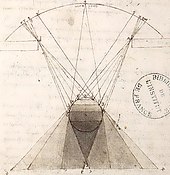
Study of the graduations of low-cal and shade on a sphere (chiaroscuro).
Low-cal [edit]
Leonardo wrote:
The lights which may illuminate opaque bodies are of 4 kinds. These are; diffused lite as that of the atmosphere; And Straight, as that of the sun; The tertiary is Reflected calorie-free; and there is a 4th which is that which passes through [translucent] bodies, every bit linen or paper etc.[five]
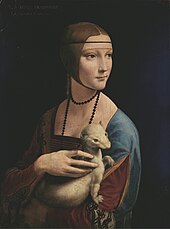
For an artist working in the 15th century, some study of the nature of light was essential. It was past the effective painting of lite falling on a surface that modelling, or a three-dimensional advent was to be achieved in a 2-dimensional medium. It was also well understood by artists like Leonardo'due south teacher, Verrocchio, that an appearance of space and distance could be achieved in a background landscape by painting in tones that were less in dissimilarity and colors that were less bright than in the foreground of the painting. The effects of light on solids were achieved by trial and error, since few artists except Piero della Francesca really had accurate scientific knowledge of the subject.
At the time when Leonardo commenced painting, it was unusual for figures to be painted with farthermost dissimilarity of light and shade. Faces, in particular, were shadowed in a mode that was bland and maintained all the features and contours conspicuously visible. Leonardo broke with this. In the painting generally titled The Lady with an Ermine (about 1483) he sets the figure diagonally to the picture space and turns her caput so that her face is almost parallel to her nearer shoulder. The back of her head and the farther shoulder are deeply adumbral. Effectually the ovoid solid of her caput and across her chest and hand the light is diffused in such a way that the distance and position of the light in relation to the effigy tin be calculated.
Leonardo'south treatment of light in paintings such every bit The Virgin of the Rocks and the Mona Lisa was to change forever the way in which artists perceived calorie-free and used it in their paintings. Of all Leonardo's scientific legacies, this is probably the one that had the most immediate and noticeable effect.
Human anatomy [edit]
Leonardo wrote:
...to obtain a truthful and perfect cognition ... I have dissected more than 10 human bodies, destroying all the other members, and removing the very minutest particles of the mankind by which these veins are surrounded, ... and as one single body would non last so long, since information technology was necessary to proceed with several bodies by degrees, until I came to an end and had a complete noesis; this I repeated twice, to learn the differences...[5]

Report of the proportions of the head.
Topographic anatomy [edit]
Leonardo began the formal report of the topographical anatomy of the homo body when apprenticed to Andrea del Verrocchio. Equally a educatee he would have been taught to draw the human torso from life, to memorize the muscles, tendons and visible subcutaneous structure and to familiarise himself with the mechanics of the various parts of the skeletal and muscular structure. It was common workshop practice to have plaster casts of parts of the homo anatomy bachelor for students to report and depict.

If, as is thought to exist the case, Leonardo painted the body and arms of Christ in The Baptism of Christ on which he famously collaborated with his primary Verrocchio, then his understanding of topographical anatomy had surpassed that of his primary at an early age equally can be seen past a comparison of the arms of Christ with those of John the Baptist in the aforementioned painting.
In the 1490s he wrote about demonstrating muscles and sinews to students:
Remember that to be certain of the point of origin of whatever muscle, you must pull the sinew from which the muscle springs in such a way as to see that muscle move, and where it is attached to the ligaments of the basic.[5]
His connected investigations in this field occupied many pages of notes, each dealing systematically with a particular aspect of beefcake. It appears that the notes were intended for publication, a task entrusted on his decease to his student Melzi.
In conjunction with studies of aspects of the torso are drawings of faces displaying unlike emotions and many drawings of people suffering facial deformity, either congenital or through illness. Some of these drawings, mostly referred to as "caricatures", on analysis of the skeletal proportions, appear to be based on anatomical studies.
Autopsy [edit]

As Leonardo became successful as an artist, he was given permission to dissect homo corpses at the Hospital of Santa Maria Nuova in Florence. Afterward he dissected in Milan at the infirmary Maggiore, and in Rome at the Ospedale di Santo Spirito (the commencement mainland Italian infirmary). From 1510 to 1511 he collaborated in his studies with the md Marcantonio della Torre.
I have removed the peel from a man who was so shrunk by illness that the muscles were worn down and remained in a state like thin membrane, in such a manner that the sinews instead of merging in muscles concluded in wide membrane; and where the bones were covered past the peel they had very little over their natural size.[v]
In xxx years, Leonardo dissected 30 male and female corpses of dissimilar ages. Together with Marcantonio, he prepared to publish a theoretical work on anatomy and made more 200 drawings. Nevertheless, his book was published only in 1680 (161 years later on his decease) under the heading A Treatise on Painting.

The organs of a woman's torso
Among the detailed images that Leonardo drew are many studies of the human skeleton. He was the first to describe the double S class of the backbone. He also studied the inclination of pelvis and sacrum and stressed that sacrum was not compatible, but composed of five fused vertebrae. He also studied the anatomy of the human foot and its connection to the leg, and from these studies, he was able to further his studies in biomechanics.
Leonardo was a physiologist as well every bit an anatomist, studying the part of the human body as well as examining and recording its structure. He dissected and drew the human being skull and cross-sections of the brain, transversal, sagittal, and frontal. These drawings may be linked to a search for the sensus communis, the locus of the man senses,[ citation needed ] which, by Medieval tradition, was located at the exact physical center of the skull.

Studies of a fœtus from Leonardo's journals
Leonardo studied internal organs, being the first to draw the homo appendix and the lungs, mesentery, urinary tract, reproductive organs, the muscles of the neck and a detailed cross-section of coitus. He was i of the showtime to draw a scientific representation of the fetus in the intrautero.
Leonardo studied the vascular organisation and drew a dissected eye in detail. He correctly worked out how heart valves ebb the flow of blood nonetheless he did not fully understand apportionment, as he believed that blood was pumped to the muscles where it was consumed. In 2005 a Britain heart surgeon, Francis Wells, from Papworth Infirmary Cambridge, pioneered repair to damaged hearts, using Leonardo's depiction of the opening stage of the mitral valve to operate without changing its diameter assuasive an individual to recover more quickly. Wells said "Leonardo had a depth of appreciation of the beefcake and physiology of the body – its structure and function – that mayhap has been overlooked by some."[6]
Leonardo's observational acumen, cartoon skill, and the clarity of depiction of os structures reveal him at his finest as an anatomist. Still, his depiction of the internal soft tissues of the trunk are incorrect in many means, showing that he maintained concepts of anatomy and functioning that were in some cases millennia old, and that his investigations were probably hampered by the lack of preservation techniques available at the time. Leonardo's detailed cartoon of the internal organs of a woman (See left) reveal many traditional misconceptions.[7] [viii]
Leonardo'southward study of human anatomy led also to the pattern of an automaton which has come to exist called Leonardo's robot, was probably made around the yr 1495 just was rediscovered but in the 1950s.
Comparative anatomy [edit]

Comparing of the leg of a human being and a dog.
Leonardo non only studied human anatomy, but the beefcake of many other animals besides. He dissected cows, birds, monkeys and frogs, comparison in his drawings their anatomical structure with that of humans. On one folio of his journal Leonardo drew five profile studies of a equus caballus with its teeth bared in anger and, for comparing, a snarling lion and a snarling man.
I have constitute that in the composition of the human trunk as compared with the bodies of animals, the organs of sense are duller and coarser... I accept seen in the King of beasts tribe that the sense of aroma is continued with part of the substance of the brain which comes down the nostrils, which form a spacious receptacle for the sense of odour, which enters past a great number of cartilaginous vesicles with several passages leading upward to where the brain, every bit before said, comes down.[five]
In the early 1490s Leonardo was commissioned to create a monument in honour of Francesco Sforza. In his notebooks are a serial of plans for an equestrian monument. There are likewise a large number of related anatomical studies of horses. They include several diagrams of a continuing equus caballus with the angles and proportions annotated, anatomical studies of horses' heads, a dozen detailed drawings of hooves and numerous studies and sketches of horses rearing.
He studied the topographical beefcake of a bear in detail, making many drawings of its paws. At that place is also a drawing of the muscles and tendons of the bear's hind feet. Other drawings of particular interest include the uterus of a meaning cow, the hindquarters of a decrepit mule and studies of the musculature of a lilliputian domestic dog.
Botany [edit]
The science of botany was long established by Leonardo'southward time, a treatise on the subject field having been written as early as 300 BCE.[ix] Leonardo's study of plants, resulting in many beautiful drawings in his notebooks, was not to record in diagramatic form the parts of the plant, but rather, as an artist and observer to tape the precise appearance of plants, the manner of growth and the way that individual plants and flowers of a single variety differed from one another.
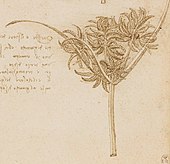
Ane such study shows a folio with several species of flower of which x drawings are of wild violets. Along with a drawing of the growing plant and a item of a leaf, Leonardo has repeatedly fatigued unmarried flowers from different angles, with their heads gear up differently on the stem.
Autonomously from flowers the notebooks contain many drawings of crop plants including several types of grain and a diversity of berries including a detailed study of bramble. At that place are also h2o plants such equally irises and sedge. His notebooks also direct the artist to observe how light reflects from foliage at different distances and nether different atmospheric conditions.
A number of the drawings have their equivalents in Leonardo's paintings. An elegant study of a stem of lilies may have been for one of Leonardo's early Announcement paintings, carried in the mitt of the Archangel Gabriel. In both the Annunciation pictures the grass is dotted with blossoming plants.
The plants which appear in both the versions of The Virgin of the Rocks reflects the results of Leonardo's studies in a meticulous realism that makes each plant readily identifiable to the botanist.
In A Treatise on Painting, Leonardo proposed the following branching dominion:
All the branches of a tree at every stage of its height when put together are equal in thickness to the trunk [below them].[5]
Geology [edit]
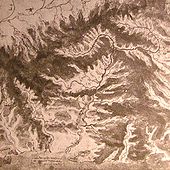
As an adult, Leonardo had but two childhood memories, one of which was the finding of a cave in the Apennines. Although fearing that he might exist attacked past a wild brute, he ventured in driven "by the burning want to see whether at that place might be any marvelous matter inside."
Leonardo's earliest dated drawing is a study of the Arno valley, strongly emphasizing its geological features. His notebooks contain landscapes with a wealth of geological observation from the regions of both Florence and Milan, oft including atmospheric effects such as a heavy rainstorm pouring down on a boondocks at the foot of a mountain range.
Information technology had been observed for many years that strata in mountains often contained bands of sea shells. Conservative science said that these could be explained by the Great Flood described in the Bible. Leonardo'southward observations convinced him that this could not maybe be the case.

And a piddling beyond the sandstone conglomerate, a tufa has been formed, where information technology turned towards Castel Florentino; farther on, the mud was deposited in which the shells lived, and which rose in layers co-ordinate to the levels at which the turbid Arno flowed into that body of water. And from fourth dimension to fourth dimension the bottom of the sea was raised, depositing these shells in layers, every bit may be seen in the cutting at Colle Gonzoli, laid open by the Arno which is wearing away the base of operations of it; in which cut the said layers of shells are very plainly to be seen in clay of a bluish colour, and diverse marine objects are found there.[5]
This quotation makes clear the breadth of Leonardo's understanding of geology, including the action of water in creating sedimentary rock, the tectonic activity of the World in raising the bounding main bed and the action of erosion in the creation of geographical features.
In Leonardo'south earliest paintings we come across the remarkable attention given to the pocket-size landscapes of the background, with lakes and water, swathed in a misty light. In the larger of the Announcement paintings is a boondocks on the edge of a lake. Although afar, the mountains tin be seen to be scored by vertical strata. This characteristic tin can be observed in other paintings by Leonardo, and closely resembles the mountains around Lago di Garda and Lago d'Iseo in Northern Italy. It is a particular feature of both the paintings of The Virgin of the Rocks, which as well include caverns of fractured, tumbled, and water-eroded limestone.[10]
Cartography [edit]

Leonardo's authentic map of Imola for Cesare Borgia.
In the early 16th century maps were rare and oft inaccurate. Leonardo produced several extremely authentic maps such equally the boondocks plan of Imola created in 1502 in lodge to win the patronage of Cesare Borgia. Borgia was so impressed that he hired him as a military engineer and architect. Leonardo also produced a map of Chiana Valley in Tuscany, which he surveyed, without the benefit of modern equipment, past pacing the distances. In 1515, Leonardo produced a map of the Roman Southern Coast which is linked to his work for the Vatican and relates to his plans to drain the marshland.
Recent research past Donato Pezzutto suggests that the background landscapes in Leonardo's paintings depict specific locations as aerial views with enhanced depth, employing a technique called cartographic perspective. Pezzutto identifies the location of the Mona Lisa to the Val di Chiana, the Announcement to the Arno Valley, the Madonna of the Yarnwinder to the Adda Valley and The Virgin and Child with St Anne to the Sessia Valley.[11]
Hydrodynamics [edit]

Leonardo wrote:
All the branches of a water [grade] at every phase of its course, if they are of equal rapidity, are equal to the torso of the principal stream.[v]
Amid Leonardo's drawings are many that are studies of the motion of h2o, in item the forms taken by fast-flowing water on striking different surfaces.
Many of these drawings draw the spiralling nature of water. The screw form had been studied in the fine art of the Classical era and strict mathematical proportion had been applied to its employ in art and compages. An awareness of these rules of proportion had been revived in the early Renaissance. In Leonardo's drawings can exist seen the investigation of the spiral equally it occurs in h2o.
In that location are several elaborate drawings of h2o curling over an object placed at a diagonal to its class. At that place are several drawings of h2o dropping from a pinnacle and curling upwards in spiral forms. One such drawing, as well every bit crimper waves, shows splashes and details of spray and bubbles.
Leonardo'southward interest manifested itself in the cartoon of streams and rivers, the action of water in eroding rocks, and the cataclysmic action of water in floods and tidal waves. The noesis that he gained from his studies was employed in devising a range of projects, specially in relation to the Arno River. None of the major works was brought to completion.
Astronomy [edit]
Leonardo lived at a time when geocentric theories were the well-nigh widely used explanations to account for the relationship between the Earth and Sun'south motility. He wrote that "The Sun has substance, shape, move, radiance, heat, and generative power; and these qualities all emanate from itself without its diminution."[12] He further wrote,
The earth is not in the heart of the Lord's day's orbit nor at the centre of the universe, but in the centre of its companion elements, and united with them. And whatsoever one standing on the moon, when it and the sun are both below us, would see this our globe and the element of water upon it simply every bit we run into the moon, and the earth would calorie-free it as it lights u.s.a..[thirteen]
In one of his notebooks, at that place is a annotation in the margin which states, "The Sun does not move," which may indicate Leonardo's support of heliocentrism.[14]
Alchemy [edit]
Claims are sometimes fabricated that Leonardo da Vinci was an alchemist. He was trained in the workshop of Verrocchio, who according to Vasari, was an able alchemist. Leonardo was a chemist in so much as that he experimented with different media for suspending pigment paint. In the painting of murals, his experiments resulted in notorious failures with The Last Supper deteriorating within a century, and The Battle of Anghiari running off the wall. In Leonardo's many pages of notes about artistic processes, at that place are some that pertain to the utilise of silver and gold in artworks, information he would accept learned as a student.[fifteen]
Leonardo's scientific process was based mainly upon observation. His practical experiments are also founded in ascertainment rather than conventionalities. Leonardo, who questioned the society of the Solar System and the eolith of fossils past the Swell Flood, had petty fourth dimension for the alchemical quests to plough atomic number 82 into gold or create a potion that gave eternal life.
Leonardo said well-nigh alchemists:
The imitation interpreters of nature declare that quicksilver is the mutual seed of every metallic, not remembering that nature varies the seed co-ordinate to the variety of the things she desires to produce in the world.[five] [sixteen]
Erstwhile alchemists... take never either by take chances or by experiment succeeded in creating the smallest element that can be created by nature; however [they] deserve unmeasured praise for the usefulness of things invented for the use of men, and would deserve information technology even more if they had not been the inventors of noxious things like poisons and other similar things which destroy life or mind." [17]
And many have fabricated a merchandise of delusions and false miracles, deceiving the stupid multitude.[five]
Mathematical studies [edit]
Perspective [edit]
The art of perspective is of such a nature as to make what is apartment appear in relief and what is in relief flat.[5]
During the early 15th century, both Brunelleschi and Alberti fabricated studies of linear perspective. In 1436 Alberti published De pictura ("On Painting"), which includes his findings on linear perspective. Piero della Francesca carried his work forrad and by the 1470s a number of artists were able to produce works of art that demonstrated a full understanding of the principles of linear perspective.

Leonardo studied linear perspective and employed it in his earlier paintings. His use of perspective in the two Annunciations is daring, every bit he uses diverse features such every bit the corner of a building, a walled garden and a path to contrast enclosure and spaciousness.
The unfinished Adoration of the Magi was intended to be a masterpiece revealing much of Leonardo'due south knowledge of figure drawing and perspective. There exists a number of studies that he made, including a detailed study of the perspective, showing the complex groundwork of ruined Classical buildings that he planned for the left of the pic. In addition, Leonardo is credited with the starting time use of anamorphosis, the use of a "perspective" to produce an image that is intelligible simply with a curved mirror or from a specific vantage point.[eighteen]
Leonardo wrote:
Those who are in dear with practice without knowledge are like the crewman who gets into a ship without rudder or compass and who never tin can exist sure whether he is going. Practice must always be founded on audio theory, and to this Perspective is the guide and the gateway; and without this zip can be done well in the matter of drawing.[5]
Geometry [edit]

While in Milan in 1496, Leonardo met a traveling monk and bookish, Luca Pacioli. Under him, Leonardo studied mathematics. Pacioli, who first codified and recorded the double entry system of bookkeeping,[19] had already published a major treatise on mathematical knowledge, collaborated with Leonardo in the production of a book called De divina proportione well-nigh mathematical and creative proportion. Leonardo prepared a serial of drawings of regular solids in a skeletal form to exist engraved equally plates. De divina proportione was published in 1509.
All the bug of perspective are made articulate past the five terms of mathematicians, which are:—the point, the line, the angle, the superficies and the solid. The point is unique of its kind. And the point has neither height, breadth, length, nor depth, whence it is to be regarded equally indivisible and every bit having no dimensions in space.[five]
Applied science and invention [edit]
Vasari in The Lives says of Leonardo:
He fabricated designs for mills, fulling machines and engines that could be driven by water-power... In addition he used to make models and plans showing how to excavate and tunnel through mountains without difficulty, so equally to laissez passer from i level to another; and he demonstrated how to lift and describe bang-up weights by means of levers, hoists and winches, and means of cleansing harbours and using pumps to suck upwards water from nifty depths.
Practical inventions and projects [edit]

A machine for grinding convex lenses
With the same rational and analytical approach that he used in anatomic studies, Leonardo faced the study and design of a bewildering number of machines and devices. He drew their "anatomy" with unparalleled mastery, producing the first form of the modern technical drawing, include a perfected "exploded view" technique, to represent internal components. Those studies and projects take been collected in his codices and make full more 5,000 pages.[20] Leonardo was a chief of mechanical principles. He utilized leverage and cantilevering, pulleys, cranks, gears, including angle gears and rack and pinion gears; parallel linkage, lubrication systems and bearings. He understood the principles governing momentum, centripetal force, friction and the aerofoil and applied these to his inventions. His scientific studies remained unpublished with, for instance, his manuscripts describing the processes governing friction predating the introduction of Amontons' laws of friction past 150 years.[21]
It is incommunicable to say with any certainty how many or even which of his inventions passed into general and applied apply, and thereby had impact over the lives of many people. Among those inventions that are credited with passing into full general practical use are the strut bridge, the automated bobbin winder, the rolling mill, the machine for testing the tensile strength of wire and the lens-grinding motorcar pictured at correct. In the lens-grinding machine, the mitt rotation of the grinding bicycle operates an bending-gear, which rotates a shaft, turning a geared dish in which sits the glass or crystal to be ground. A single action rotates both surfaces at a stock-still speed ratio determined by the gear.
Every bit an inventor, Leonardo was not prepared to tell all that he knew:
How by means of a sure machine many people may stay some time nether water. How and why I do not describe my method of remaining under h2o, or how long I can stay without eating; and I exercise not publish nor divulge these by reason of the evil nature of men who would use them every bit means of devastation at the bottom of the sea, by sending ships to the bottom, and sinking them together with the men in them. And although I volition impart others, at that place is no danger in them; because the mouth of the tube, past which you lot breathe, is above the water supported on numberless of corks.[5]
Bridges and hydraulics [edit]

Diverse hydraulic machines
Leonardo's study of the motility of water led him to design mechanism that utilized its force. Much of his work on hydraulics was for Ludovico il Moro. Leonardo wrote to Ludovico describing his skills and what he could build:
...very low-cal and strong bridges that tin hands be carried, with which to pursue, and sometimes flee from, the enemy; and others safe and indestructible past fire or assail, easy and convenient to transport and identify into position.
Amidst his projects in Florence was 1 to divert the class of the Arno, in lodge to flood Pisa. Fortunately, this was too costly to exist carried out. He also surveyed Venice and came upwards with a program to create a movable dyke for the city's protection against invaders.
In 1502, Leonardo produced a drawing of a single bridge 240 m (720 ft) bridge as part of a civil technology project for Ottoman Sultan Beyazid Ii of Istanbul. The bridge was intended to span an inlet at the mouth of the Bosphorus known as the Gilt Horn. Beyazid did not pursue the project, because he believed that such a construction was incommunicable. Leonardo'southward vision was resurrected in 2001 when a smaller span based on his design was synthetic in Norway. A stone model of the bridge was evaluated in 2019 by MIT researchers. The self-supporting one:500 scale model was built from 126 3D-printed stone cross-sections, held together without mortar. Researchers concluded that the bridge would've been able to support its own weight, and maintain stability nether load and wind shear forces.[22]
War machines [edit]
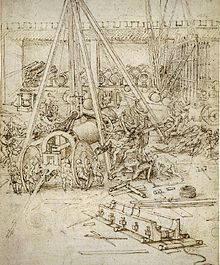
Leonardo's letter to Ludovico il Moro assured him:
When a place is besieged I know how to cut off water from the trenches and construct an infinite multifariousness of bridges, mantlets and scaling ladders, and other instruments pertaining to sieges. I also have types of mortars that are very convenient and easy to send.... when a place cannot be reduced by the method of bombardment either because of its height or its location, I have methods for destroying whatever fortress or other stronghold, even if it be founded upon rock. ....If the engagement exist at body of water, I accept many engines of a kind most efficient for offence and defense force, and ships that can resist cannons and powder.
In Leonardo's notebooks there is an array of war machines which includes a vehicle to exist propelled by two men powering crank shafts. Although the drawing itself looks quite finished, the mechanics were apparently not fully developed because, if built equally drawn, the vehicle would never progress in a forward management. In a BBC documentary, a military squad built the car and changed the gears in order to make the machine work. It has been suggested that Leonardo deliberately left this error in the blueprint, in order to prevent it from existence put to practice by unauthorized people.[23] Another automobile, propelled by horses with a pillion rider, carries in front end of it 4 scythes mounted on a revolving gear, turned past a shaft driven past the wheels of a cart backside the horses.

Leonardo's proposed vehicle
Leonardo's notebooks also bear witness cannons which he claimed "to bung small stones like a storm with the fume of these causing keen terror to the enemy, and great loss and confusion." He as well designed an enormous crossbow. Following his detailed cartoon, one was constructed past the British Regular army, simply could not exist made to fire successfully. In 1481 Leonardo designed a breech-loading, h2o cooled cannon with three racks of barrels allowed the re-loading of one rack while some other was being fired and thus maintaining continuous fire power. The "fan type" gun with its array of horizontal barrels allowed for a broad handful of shot.
Leonardo was the outset to sketch the wheel-lock musket c. 1500 Advertisement (the precedent of the flintlock musket which get-go appeared in Europe by 1547), although as early as the 14th century the Chinese had used a flintlock 'steel bicycle' in order to detonate land mines.[24]
While Leonardo was working in Venice, he drew a sketch for an early diving suit, to be used in the destruction of enemy ships entering Venetian waters. A arrange was constructed for a BBC documentary using pigskin treated with fish oil to repel water. The head was covered by a helmet with 2 eyeglasses at the front. A breathing tube of bamboo with pigskin joints was attached to the back of the helmet and connected to a float of cork and wood. When the scuba divers tested the suit, they found information technology to be a workable forerunner to a modern diving adjust, the cork bladder interim every bit a compressed air chamber when submerged.[25] His inventions were very futuristic which meant they were very expensive and proved not to be useful.
Flight [edit]
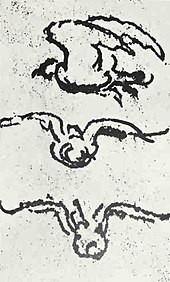
In Leonardo's infancy a hawk had in one case hovered over his cradle. Recalling this incident, Leonardo saw it as prophetic:
An object offers as much resistance to the air as the air does to the object. You may come across that the beating of its wings confronting the air supports a heavy eagle in the highest and rarest atmosphere, close to the sphere of elemental burn down. Again you may encounter the air in motion over the sea, fill the swelling sails and drive heavily laden ships. From these instances, and the reasons given, a man with wings large plenty and duly connected might acquire to overcome the resistance of the air, and by conquering information technology, succeed in subjugating it and rising higher up it.[5]
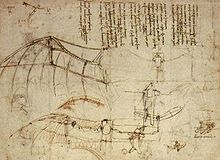
Design for a flight machine with wings based closely upon the structure of a bat'southward wings.
The desire to fly is expressed in the many studies and drawings. His later journals contain a detailed study of the flight of birds and several unlike designs for wings based in construction upon those of bats which he described as existence less heavy considering of the impenetrable nature of the membrane. In that location is a legend that Leonardo tested the flying machine on Monte Ceceri with one of his apprentices, and that the amateur fell and broke his leg.[26] Experts Martin Kemp and Liana Bortolon agree that there is no evidence of such a test, which is not mentioned in his journals.
One design that he produced shows a flight motorcar to be lifted by a man-powered rotor.[27] It would not have worked since the torso of the craft itself would take rotated in the contrary direction to the rotor.[28]
While he designed a number of man powered flying machines with mechanical wings that flapped, he also designed a parachute and a light hang glider which could have flown.[29]
Musical instrument [edit]

The viola organista was an experimental musical instrument invented by Leonardo da Vinci. It was the commencement bowed keyboard musical instrument (of which any record has survived) e'er to exist devised.
Leonardo's original thought, as preserved in his notebooks of 1488–1489 and in the drawings in the Codex Atlanticus, was to utilize one or more wheels, continuously rotating, each of which pulled a looping bow, rather like a fanbelt in an automobile engine, and perpendicular to the musical instrument's strings.
Leonardo's inventions fabricated reality [edit]

In the tardily 20th century, involvement in Leonardo'due south inventions escalated. In that location have been many projects which have sought to plough diagrams on newspaper into working models. One of the factors is the awareness that, although in the 15th and 16th centuries Leonardo had available a limited range of materials, modern technological advancements have made bachelor a number of robust materials of light-weight which might turn Leonardo'south designs into reality. This is particularly the case with his designs for flight machines.
A difficulty encountered in the creation of models is that oft Leonardo had not entirely thought through the mechanics of a auto before he drew it, or else he used a sort of graphic shorthand, just non bothering to describe a gear or a lever at a signal where i is essential in club to brand a car function. This lack of refinement of mechanical details can cause considerable confusion. Thus, many models that are created, such as some of those on display at Clos Lucé, Leonardo's abode in France, do not piece of work, but would work, with a lilliputian mechanical tweaking.
Accidental perspective and anamorphosis [edit]

Anamorphosis [edit]
...And if you will paint this on a wall in front of which you lot can move freely, it will expect out of proportion… and if notwithstanding that you still wish to paint it, information technology will exist necessary that your perspective is seen through a single hole…
Leonardo was the writer of some of the primeval known examples of pictorial anamorphosis identified and studied.[30] [31] Anamorphosis is a type of optical artifice in which images are represented with contradistinct proportions, and are recognizable only when the paradigm is observed from a specific vantage signal or using distorting instruments. A notable example in painting is The Ambassadors (1533) past Hans Holbein the Younger.

Leonardo da Vinci: Tool for the bending of contingency reconstructed from the Codex Atlanticus
Instruments [edit]
One of the instruments used by Leonardo for his inquiry on anamorphosis was the tool for the bending of contingence, recreated in modernistic times using the Codex Atlanticus.[32] Information technology is an musical instrument to decide the reflexion angle of a ray of light incident on the surface of a cylindrical mirror.
Outset examples [edit]
The first examples of Leonardo'south studies on anamorphosis tin exist constitute both in his treatise Treatise on Painting ("Rules for the Painter")[33] and in the Codex Atlanticus.[32] 2 anamorphic drawings of the Codex Atlanticus, representing the caput of a infant and an middle, are examples of plane anamorphosis.[34] [35]

2 anamorphic drawings, a face of a baby and an eye in Codex Atlanticus page 98 recto.
The two drawings can exist adapted when observed from a foreshortening angle, placing the eye on the right side of the canvas, near middle height. The original newspaper displays a preparation with a bundle of lines traced with a metal tip within which the figures are inscripted; these lines are invisible in any reproduction.[36] [37] [38] A affiliate in the Codex Arundel 263 (c.62, 9r.) with the title "On natural perspective mixed with accidental perspective" explains how to utilize an accidental viewpoint to that of a natural surface, in order for the moving observer to obtain the vision of a "monstrous" figure. This was the procedure used to reach the "Fight Between a Dragon and a Lion" and Painting with Horses, and so peculiar as to concenter the attention of Francis I of France demonstrating the presence of a geometric construction underlying the sketches, which tin can be seen in their real proportions merely observing them with the usual technique needed for 'anamorphic' paintings.
According to Jurgis Baltrušaitis these are some of the oldest examples of anamorphosis known at the time, and with reference to the technique he stated:
...undoubtedly at offset the recipes were kept closely undercover, the verbal geometric procedures were integrally revealed simply during the XVII century, with the creation of the 2d grouping of anamorphoses and its spreading in multiple directions...[36]
Other studies on this topic were later reinforced and widened by Panofsky (1940) and White (1957).[39] The Codex A[40] of the Institut de France includes the description of a technique to build an anamorphosis using a hole through which letting a ray of light project the shadow of what is to exist fatigued on a defended wall. This cartoon technique is defined by Leonardo as "accidental perspective", in which farther objects needed to be drawn bigger than close ones, in contrast with what is observed in reality ("natural perspective").
Anamorphic virtuosities [edit]
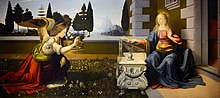
In the Uffizi Annunciation, sparsely documented early on work by Leonardo once wrongly attributed to Domenico Ghirlandaio, the shortcomings, mistakes, including a seemingly gross perspective one and the subsequent doubts concerning its authorship, were caused by the failure to empathize the principles of anamorphosis. Mary in the painting is represented reading in the garden, when she is surprised by the arrival of Archangel Gabriel, the Virgin looks almost gloomy, while her right paw chastely appears to hold dorsum the annunciation of the divine messenger. In Leonardo's composition, the bookstand where the Virgin lays her right manus, constrains her in an unusual position. Observing the painting from a key point of view, when looked at frontally; the limb appears too long and unjointed, almost unnatural. Merely thanks to the remarks of Carlo Pedretti'south[41] (one of the greatest experts of Leonardo) and Antonio Natali'south,[42] (Managing director of the Uffizi), it is at present understood that when observed from a vantage bespeak, non merely the arm appears perfectly proportioned, simply besides Archangel Gabriel, that could have looked as well off balance alee, regains a more natural pose.[43] [44] The erroneous attempt to blame this seeming imperfection to the young author'southward inexperience is overcome by the clear apply of an anamorphic composition of the painting by Leonardo, following the case of other great artists of the early on Renaissance, such every bit Florentine artists Donatello and Filippo Lippi. The errors of perspective tin be summarized as follows: the Virgin'southward right arm existence longer than the left one, too curt legs compared to the height of the torso, the cypress dislocated with the fifteenth-century building, making it appear bigger, the dissimilar placing of the Virgin's legs and shoulders relative to the bookstand. The error of perspective is the event of the will of the painter, and arises from the need to accommodate the placing of the painting on a wall that would have been looked at mainly in foresight from the right; it is actually observing the Proclamation from a right sided lateral position that the disproportion of the arm subsides, every bit an consequence of the anamorphosis.
Leonardo's projects [edit]
-
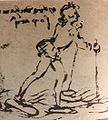
Walking on water
-

A parabolic compass
-

A h2o powered gyroscopic compass
-

Cannons (Firing)
-
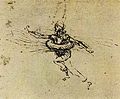
Sketch of a lifebelt
Models based on Leonardo's drawings [edit]
-

Model of a Leonardo span
-

Model of Leonardo's parachute
-

Model after Leonardo'south design for the Golden Horn Bridge
-

Model of a fighting vehicle by Leonardo
-

Model of a flywheel
Exhibitions [edit]
- Leonardo da Vinci Gallery at Museo Nazionale Scienza e Tecnologia Leonardo da Vinci in Milan; permanent exhibition, the biggest collection of Leonardo's projects and inventions.[45]
- Models of Leonardo's designs are on permanent display at Clos Lucé.
- The Victoria and Albert Museum, London, held an exhibition called "Leonardo da Vinci: Experience, Experiment, and Design" in 2006
- Logitech Museum
- "The Da Vinci Machines Exhibition" was held in a pavilion in the Cultural Forecourt, at South Depository financial institution, Brisbane, Queensland, Australia in 2009. The exhibits shown were on loan from the Museum of Leonardo da Vinci, Florence, Italy.
Tv set programs [edit]
- The U.S. Public Dissemination Service (PBS), aired in October 2005, a television programme called Leonardo'due south Dream Machines, virtually the building and successful flight of a glider based upon Leonardo'due south design.
- The Discovery Aqueduct began a series called Doing DaVinci in Apr 2009, in which a team of builders try to construct various inventions of Leonardo based on his designs.[46]
See as well [edit]
- List of works by Leonardo da Vinci
- Ostrich Egg Globe
- Personal life of Leonardo da Vinci
Notes [edit]
- ^ Innocenzi, Plinio (2018). The innovators behind Leonardo: The True Story of the Scientific and Technological Renaissance. Cham: Springer International Publishing. ISBN9783319904481.
- ^ Marc van den Broek (2019), Leonardo da Vinci Spirits of Invention. A Search for Traces, Hamburg: A.TE.M., ISBN978-3-00-063700-i
- ^ Capra, Fritjof. The Scientific discipline of Leonardo; Inside the Mind of the Genius of the Renaissance. (New York, Doubleday, 2007)
- ^ Wallace 1972, p. 170.
- ^ a b c d e f thou h i j k l m n o p q Jean Paul Richter editor 1880, The Notebooks of Leonardo da Vinci Dover, 1970, ISBN 0-486-22572-0. (accessed 2007-02-04)
- ^ "Da Vinci inkling for heart surgeon". BBC News. 2005-09-28. Retrieved 2013-07-18 .
- ^ Martin Kemp, Leonardo, Oxford University Press, (2004) ISBN 0-nineteen-280644-0
- ^ Alive Scientific discipline
- ^ E.yard. Theophrastus, On the History of Plants.
- ^ The London painting of the Virgin of the Rocks is denounced by the geologist Ann C. Pizzorusso, [i] of New York, as largely by the hand of someone other than Leonardo, because the rocks appear incongruous and the lake looks like a fjord. Pizzorusso says "Fjords do not exist in Italia and information technology is highly unlikely the glacial lakes of the Lombard region would have such steep relief surrounding them." In fact, the glacial lake, Garda, has just such steep geological formations. The sedimentary ruby limestone which appears in the pic is also typical of Italian republic.
- ^ Pezzutto, Donato (2012-x-24). "Leonardo's Landscapes as Maps". OPUSeJ. Retrieved 2012-11-07 .
- ^ Livio, Dr. Mario (8 October 2013). "The Da Vinci Astronomy". Huff Post . Retrieved 2 March 2020.
- ^ Da Vinci'south notebooks on astronomy.
- ^ "Leonardo Da Vinci". Giants of Science . Retrieved 2 March 2020.
- ^ Bruce T. Moran, Distilling Noesis, Chemistry, Alchemy and the Scientific Revolution, (2005) ISBN 0-674-01495-ii
- ^ "Quicksilver" is an quondam proper noun for mercury.
- ^ Irma Ann Richter and Teresa Wells, Leonardo da Vinci – Notebooks, Oxford University Printing (2008) ISBN 978-0-19-929902-vii
- ^ "Animations of anamorphosis of Leonardo and other artists". Illusionworks.com. Retrieved 2013-07-xviii . [ dead link ]
- ^ L. Potato Smith, Luca Pacioli: The Father of Accounting Archived 2011-08-18 at the Wayback Machine
- ^ Guarnieri, M. (2019). "Reconsidering Leonardo". IEEE Industrial Electronics Magazine. 13 (3): 35–38. doi:10.1109/MIE.2019.2929366. S2CID 202729396.
- ^ "Leonardo da Vinci (1452–1519)". Nano-world.org. Retrieved 2013-07-24 .
- ^ Chandler, David L. (2019-x-09). "Engineers put Leonardo da Vinci's span design to the test". MIT News . Retrieved 2019-10-29 .
- ^ "Da Vinci war machines "designed to fail"". The Historic period. Melbourne. Dec xiv, 2002.
- ^ Needham, Volume 5, Role vii, 199.
- ^ "Youtube Video of the BBC documentary". Archived from the original on 2010-10-13.
- ^ Liana Bortolon, Leonardo, Paul Hamlyn, (1967)
- ^ "The Helicopter » Leonardo Da Vinci's Inventions". leonardodavincisinventions.com. Retrieved 2016-03-21 .
- ^ run into Helicopter for detailed clarification of solutions and types of functional helicopter.
- ^ U.S. Public Dissemination Service (PBS), Leonardo's Dream Auto, October 2005
- ^ Bassoli,F., Leonardo da Vinci e l'invenzione delle anamorfosi, in "Atti della società dei Naturalisti e Matematici in Modena" LXIX/1938
- ^ Decio Gioseffi, Perspectiva artificialis: per la storia della prospettiva. Spigolature east appunti, Smolars, Trieste, 1957
- ^ a b Pedretti, Carlo (1978). The Codex Atlanticus of Leonardo Da Vinci. San Diego, California: Harcourt. ISBN978-3840950032.
- ^ A Treatise on Painting, by Leonardo da Vinci 1721 Senex and Taylor, London
- ^ Leonardo Da Vinci, Codex Atlanticus, folio 98 recto-Biblioteca Ambrosiana, Milan, dating around 1515
- ^ ""Eyed Awry": Blind Spots and Memoria in the Zimmern Anamorphosis".
- ^ a b Baltrušaitis, Jurgis (1976) "Anamorphic Art". Trans. W.J. Strachn. Harry N. Abrams Inc. New York. Standard Book Number: 8109-0662-7. Library of Congress: 77-73789 ISBN 978-0810906624
- ^ J. Baltrusaitis , Anamorfosi o thaumaturgus opticus, Milano 2004
- ^ http://world wide web.educational.rai.information technology/materiali/file_lezioni/64888_636314928342978742.pdf[ bare URL PDF ]
- ^ White, John. The Nascency and Rebirth of Pictorial Space, London : Faber and Faber, 1957.
- ^ C. Pedretti; M. Cianchi (April 1995). "Manoscritto A". Leonardo. I codici. p. twenty.
- ^ Pedretti, Carlo (2006). Leonardo da Vinci. Surrey: Taj Books International. ISBN978-i-8440-6036-8. Pedretti, Carlo (1982). Leonardo, a study in chronology and style. Cambridge: Johnson Reprint Corp. ISBN978-0-3844-5281-vii.
- ^ Antonio Natali, La montagna sul mare. L'Annunciazione di Leonardo (2006)
- ^ "Annunciazione | Opere | le Gallerie degli Uffizi".
- ^ "Il mistero dell'Annunciazione di Leonardo, Errori o Virtuosismi".
- ^ "Leonardo". Museoscienzaorg . Retrieved May 16, 2016.
- ^ Well-nigh Doing DaVinci : Doing DaVinci : Discovery Channel Archived Apr 19, 2009, at the Wayback Motorcar
References [edit]
- Bsmbach, Carmen (2003). Leonardo da Vinci, Primary Draftsman. New Haven: Yale University Press. p. 414. ISBN0-300-09878-2.
- Wallace, Robert (1972) [1966]. The World of Leonardo: 1452–1519. New York: Fourth dimension-Life Books.
Farther reading [edit]
- Moon, Francis C. (2007). The Machines of Leonardo da Vinci and Franz Reuleaux, Kinematics of Machines from the Renaissance to the 20th Century. Springer. ISBN978-1-4020-5598-0.
- Capra, Fritjof (2007). The Science of Leonardo; Inside the Mind of the Genius of the Renaissance. New York: Doubleday.
External links [edit]
- The Fine art of War: Leonardo da Vinci's War Machines
- Complete text & images of Richter's translation of the Notebooks
- Leonardo da Vinci: Experience, Experiment, Design (review)
- Some digitized notebook pages with explanations from the British Library (Non HTML5 Bachelor)
- Digital and animated compendium of anatomy notebook pages
- BBC Leonardo homepage
- Leonardo da Vinci: The Leicester Codex
- Leonardo'southward Letter to Ludovico Sforza
- Animations of anamorphosis of Leonardo and other artists
- Da Vinci – The Genius: A comprehensive traveling exhibition well-nigh Leonardo da Vinci
- The technical drawings of Leonardo da Vinci – a loftier resolution gallery
- Leonardo da Vinci: anatomical drawings from the Imperial Library, Windsor Castle, exhibition itemize fully online every bit PDF from The Metropolitan Museum of Art
- Leonardo da Vinci, Master Draftsman, exhibition catalog fully online as PDF from The Metropolitan Museum of Art
- Leonardo da Vinci: Anatomist The Queen's Gallery, Buckingham Palace, Fri, iv May 2012 to Sunday, 7 Oct 2012. High-resolution anatomical drawings.
Source: https://en.wikipedia.org/wiki/Science_and_inventions_of_Leonardo_da_Vinci
0 Response to "How Did Leonardo Da Vincis Experiments Influence His Art"
Post a Comment